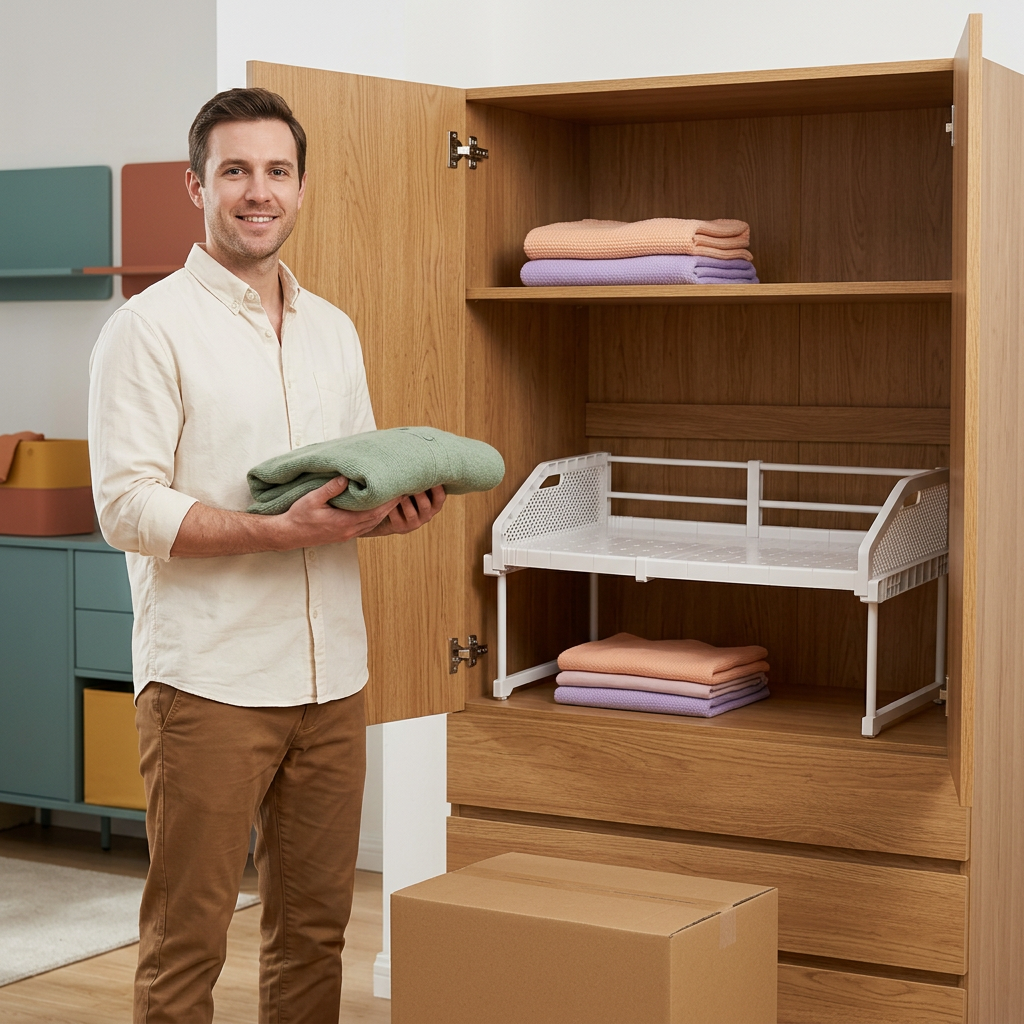
White Expandable Cabinet Shelf Riser with High Side Guards & Rear Rails, Adjustable 73–94 cm Wide Organizer for Folded Clothing and Linens
White Expandable Cabinet Shelf Riser with High Side Guards & Rear Rails, Adjustable 73–94 cm Wide Organizer for Folded Clothing and Linens
Couldn't load pickup availability

White Expandable Cabinet Shelf Riser with High Side Guards & Rear Rails, Adjustable 73–94 cm Wide Organizer for Folded Clothing and Linens
🗺️ Look at the Space Between Your Shelves
A cabinet can feel crowded even when much of its height is unused. Folded clothing sits in one tall stack, small linens disappear underneath, and reaching the item at the bottom means disturbing everything above it.
This white expandable cabinet shelf riser offers another way to plan that space. A raised platform creates an upper storage surface while leaving an area beneath for suitable shorter belongings. Rather than adding more to one pile, you can separate the contents into two more deliberate zones.
The width adjusts from 73 to 94 cm, so you can plan around a compatible cabinet instead of relying on one fixed span. High side guards and rear rails give the upper surface a defined outline, while the white finish keeps the structure visually light beside your own textiles.
↔️ Start with the Width, Not the Pile
The pictured design uses an overlapping shelf platform that extends across its stated 73–94 cm width range. This adjustment changes the horizontal span; it is not a promise of adjustable depth or adjustable leg height.
Measure the clear interior width where the riser will stand, then check whether doors, hinges or side fittings reduce the space available. A cabinet measurement taken at the front may differ from the usable width farther inside.
Choose a setting within the specified range and follow the supplied assembly instructions for the sliding sections and connections. Make width changes while the shelf is empty. Never pull on the frame to extend it while belongings remain on the platform, and do not extend beyond the stated maximum.
🧭 The Fit Check Has Three Directions
Across: allow room for the whole frame
The width range is useful only if the cabinet opening and interior can accommodate the actual unit. Check that the feet and side panels sit without pressure against the cabinet walls. This is a freestanding riser, not a tension-mounted shelf that relies on squeezing between two surfaces.
Front to back: check the 45 cm depth
The reference shows a 45 cm depth. Compare that with the usable cabinet depth, leaving room for the door to close normally. Back panels, internal fittings and the shape of the cabinet opening can all affect the fit.
Upward: leave room for guards and belongings
The reference labels the height from the supporting surface to the shelf deck as 26 cm. It also shows a 17 cm marking beside the raised side-guard area. Do not read 26 cm as the overall height of the complete unit: the guards and rear rails continue above the platform.
Allow sufficient clearance for the entire frame, the items you plan to place on top and your hands as you lift them out. The usable space beneath the platform is also affected by its thickness and supporting parts, so it should not be assumed to be a full 26 cm clear opening.
🪜 Give the Upper and Lower Zones Different Jobs
Useful layering begins with categories. If the same mixed pile simply spreads across two levels, it may still be difficult to find what you need. Decide what belongs above and what belongs below before filling the space.
Above: the items you want to see first
A modest selection of folded clothing can sit on the raised platform, arranged in manageable groups. Keep stacks low enough to lift individual pieces without hitting the shelf above. Leave breathing room between groups rather than filling every part of the surface.
Below: shorter groups with a clear purpose
Use the existing cabinet shelf beneath the riser for suitable short stacks of linens, folded accessories or other compatible belongings. Place frequently used items toward the front and avoid pushing everything so far back that the second zone becomes difficult to reach.
Both zones should support the way you actually use the cabinet. If an arrangement looks neat but requires removing several objects every time you need one, simplify the categories or reduce the contents.
🛡️ A Closer Look at the Raised Sides
The high side panels have a perforated pattern and sloped front edges. At the rear, horizontal rails with a central upright define the back of the upper platform. These details distinguish this model from a simple open-sided shelf riser.
The raised boundaries can help you organize within a visible outline, but they are not a guarantee against objects falling. Keep belongings within the shelf area, avoid leaning tall items against the guards and do not treat the rails as hanging bars.
The open front remains the main access point. Plan the position of your folded groups so you can reach them directly, without pulling them over a side panel or pressing on the rear rails.
🧵 White Structure, Your Own Textures
The shelf stays white while the character of the arrangement comes from your belongings. Sage knitwear, peach-colored linen and lavender clothing can form soft blocks of color against the perforated platform and side panels.
Alongside oak or another warm cabinet finish, the pale frame creates a clear visual break between upper and lower groups. In a white cabinet, it can sit more quietly in the background. Either way, the goal is a storage plan you can understand at a glance rather than a display you have to maintain perfectly.
The images show the finish and construction style, but do not establish an exact material composition or tested load rating. This listing does not promise a particular metal grade, heavy-duty capacity or resistance to corrosion.
🌓 A Different View of the Same Cabinet
Picture the cabinet before your reset: folded items share one surface, and the tallest stack is always the one that becomes untidy first. You know the linens are there, but reaching them means moving clothing that belongs to a different part of your routine.
Now picture a simpler arrangement. A few clothing groups sit above, while shorter linens remain below on the existing cabinet shelf. The riser fits without forcing the sides, its feet sit on a firm surface, and there is enough room to reach both areas comfortably.
The cabinet has not grown larger. You have changed how its usable height is divided, and given the contents a more readable arrangement. That is the purpose of the riser: a new layer in your plan, not a reason to overload the space.
🧰 Your Setup Sequence
Empty the chosen area. Check the condition of the supporting cabinet shelf and confirm that it can safely support the riser and intended contents.
Measure width, depth and height. Include the cabinet opening, hinges, door movement, raised guards and the space you need for access.
Assemble and adjust while empty. Follow the supplied instructions and keep the width within 73–94 cm. Check that all sections are correctly seated.
Check the footing. Both side frames must rest evenly on a firm, level supporting surface. Do not balance the feet on gaps or unsupported edges.
Begin with a light, even arrangement. Spread suitable belongings across the platform rather than concentrating them in one spot. Stop if the structure shifts, bends or becomes unstable.
Test everyday access. Open and close the cabinet, lift an item from each zone and adjust the contents if anything catches or feels awkward.
🧾 The Measurements and Features Together
- Included: One expandable freestanding cabinet shelf riser.
- Color: White.
- Version: High side-guard design.
- Adjustable width shown: 73–94 cm.
- Depth shown: 45 cm.
- Deck height shown: 26 cm, not the complete overall height.
- Side-guard marking shown: 17 cm, as illustrated in the reference.
- Platform: Perforated overlapping shelf sections.
- Frame details: Raised side panels, rear horizontal rails and two rectangular side leg frames.
- Price: $46.99 for one riser.
Clothing, linens, cabinet furniture and styling accessories are not included. Plain unbranded cartons shown in styled images are packaging concepts, not a confirmed shipping-carton specification.
🕵️ Questions Worth Asking Before You Order
Will it fit every wardrobe or cabinet?
No. Check the usable width, 45 cm depth requirement, complete frame height and access clearance. A cabinet narrower than the minimum setting is not suitable.
Is it held in place by pressure against the cabinet walls?
The reference shows a freestanding riser supported by its own side leg frames. Do not treat it as a wall-mounted or tension-supported shelf.
Can I adjust the height?
The stated adjustment is the 73–94 cm width range. Adjustable leg height is not established by the reference.
How much weight can it hold?
A tested load capacity is not provided. Do not infer heavy-duty support from the appearance or the clothing shown in styled photographs. Follow the product instructions and avoid heavy or uneven loads.
Can I stack another riser on top?
Stacking compatibility is not confirmed. Do not assume the guards or platform are designed to support another unit, and do not use the riser as a seat or step.
Does it require tools?
A complete assembly method and tool list are not established here. Follow the supplied instructions rather than assuming tool-free assembly.
🪁 Make the Next Layer a Useful One
More organized storage does not have to mean more containers. Sometimes it starts with a better division of the space you already have: a manageable group above, a useful group below and enough room to reach both.
Measure first, choose a compatible location and build your arrangement around the belongings you actually use. The adjustable width and raised-guard design give you a starting point; a thoughtful layout makes the space work for your routine.
Plan your next cabinet layer for $46.99.